Saturday, March 5, 2011

Breakfast at Ralph's Cafe

A mighty good breakfast in our little town, at Ralph's Pretty Good Cafe...


Thursday, February 24, 2011

Sheba

Sheba...our very own Egyptian Goddess...

Thursday, February 17, 2011

Sheba's learning to fetch

Sunday, February 6, 2011

February 2011

It's been a cold snowy winter so far. My two beehives went into this winter in good shape, lots of bees and lots of stored honey. But now it's looking like I may have lost one of them, but I can't be absolutely sure until close to Spring when temps get back to 50F in the daytime. Seems to be plenty of healthy activity from the hive on the right though, on the rare sunny days we've had. Nothing much else to do but wait and see. I'm glad now that I had ordered one new colony for this Spring, just in case I had a loss. Seems lots of folks are experiencing rather heavy hive losses this winter so far.

UPDATE: Feb. 14th Valentine's day-

This video shows the first winter day to hit up to fifty degrees F and sunny.
It shows that the hive I suspected had died is indeed dead, but the other hive is very active and seems quite strong and healthy. Only another two months or so of winter to go- hope they make it! They sure enjoyed the warm day today- everyone was able to go on 'cleansing flights' to relieve themselves!

Wednesday, January 26, 2011

Cats

Sadly we had to say goodbye to our beautiful kitty Pearl last month.  Pearl was such a sparkling light in our lives, and we loved her dearly. 
We'll miss our gorgeous sweet Pearl:

_____________________________________________


Shortly after Pearl passed away, we adopted a new homeless kitty from the local animal shelter. We've named her Sheba, and she is quite a beauty.  She looks a little ocelot-like, with unusual markings.  She's still only about 7 months old, so she is quite a feisty kittenish girl.  Our other cat Suki has been very patient with this new  impudent upstart.
Sheba:


Rosemary Garlic jelly


It's January...long past the season for making fruit jams and pickles, but it was easy enough to make some garlic rosemary jelly this week.  All you need is fresh rosemary and fresh garlic bulbs, vinegar, sugar, and pectin.  I love this jelly alongside any kind of roast chicken, pork, or lamb.  The hardest work is peeling all the garlic cloves (about 6 large heads' worth per dozen 8oz. jars of jelly), but it's worth it.  The house smells really good when making this jelly.  I wound up making about 22 half pints from 12 large heads of garlic and a bouquet of fresh rosemary sprigs.  That's enough for over a year of eating plus a few gift jars.

Wednesday, November 17, 2010

November beehives

One of the last sunny days above 40F degrees, and the bees are busily doing their last minute winter preparations. The metal mouseguards are tacked in place on the lower entrances, to keep mice from trying to nest in the nice cozy hive during the winter. Soon I will wrap a single layer of roofing paper around the sides of the hives to provide a little extra protection from winter winds.
A quick view of the dwindling chilly vegetable garden too, with some frost hardy spinach, kale, scallions, chard, and bok choy. Only the hardy growing things remain, and the trees are now mostly bare.

Tuesday, November 9, 2010

End of year solitary bee nests

Well it's November now, cold enough to take down my solitary and mason bee nesting blocks and store them in the unheated garage for the winter. There they will be protected from ice, freezing rain, winds, and mice.

My top wooden mason bee nesting block has about 10 tubes that are either partially or completely filled with cocoons and capped with mud...


The middle nesting site consists of two 'cans' of nesting tubes. As you can see, the bees really liked the lower can and filled almost all the 60 tubes with cocoons and mud. They used a few of the tubes in the upper can too, but only after the lower can was basically full. My best guess is that because the morning sun hits the lower can first in the chilly Spring mornings, the bees may have liked that warmth...


The bottom wooden block was specially made with smaller diameter tubes of 1/4"- I was experimenting to see if that would attract the smaller leafcutter bees, which I have read like slightly smaller tubes than the blue orchard bees use. I didn't see much action there this year, but I did put the box up a little late in the season.
However, late in the summer there was one single very small bee who kept coming and going there, and it managed to fill just ONE tube before it disappeared. I noticed the tube was not capped with the usual brown mud. Instead, it was capped by a strange dark black-green mash that seemed like dark green tar. It looked to be a paste made from chewed leaves or vegetation. Because it didn't appear to use any neatly cut leaf pieces, but used a paste instead, I am wondering if it is something different from a leafcutter bee.
I'll be asking around to try to figure out what kind of bee uses this capping. The bee itself was a bit hard to see when it was working- somewhat non-descript and very small and fast moving...but it did look appear to be a bee rather than a wasp. I will be watching this tube very carefully next Spring!...click the picture for a close up view:


In all, I started my first Spring of mason/solitary bees with six bought tubes of blue orchard mason bees....and wound up with two or perhaps three species of solitary bee cocoons, filling between 60-70 tubes.  I estimate each tube has anywhere between 3 and 5 cocoons in it, so that will be around 180 to 350 new little solitary bees emerging next Spring to populate the neighborhood!  :)  I will have to add at least one more nesting box, for sure.  I may try to get a neighbor or two involved.

Tuesday, November 2, 2010

Apple sauce, Halloween 2010


We made apple sauce all day on Halloween this year. We bought a full bushel of Jona Gold apples at a local orchard and set up our kitchen assembly line. Brian peeled and cored the apples on our little hand crank coring machine, and he got each big pot of apples cooking- stirring, adding about 1/2 to one cup of water, and a few dashes of cinammon.
My job was to fill the sterilized pint jars with the finished apple sauce, process the jars in the boiling canning bath for 15 minutes, then give the lids a final tightening and let cool, making sure they sealed properly. I like to hear the little metallic "ping!" of each lid as its vacuum dimple pops in while the jars cool in stacks on the kitchen table. I think of it as little temple bells ringing.
One bushel yielded 38 pints (19 quarts) of really good apple sauce. We figure if we eat an average of one pint per week (and don't give away more than a couple of jars), this will last us into next June, when fresh fruit will again be available locally.


Friday, October 29, 2010

Fiddle and Banjo


Friday, October 22, 2010

Double Rainbow

Last month in September after an autumn rainstorm, we saw an incredible, once-in-a-lifetime double rainbow arching completely over the field right behind our back yard. To say it was breathtaking is an understatement. It lasted about 20 minutes. The best part was how it divided the whole sky into dark and light in a strange shimmering way, splitting the entire sky perfectly into dark and light. The hill and trees underneath the rainbow were similarly split between deep shadow and brilliant sun.

My little digital camera could not capture the vast spread of it across the sky, so I had to take photos of the left side, right side, and middle, and then piece the parts by hand into a composite panorama, the result of which you see here. We'll never see anything like this again. Click on the photo to enlarge it to full size.


A friend of mine who was down the hill right in the village on Main Street at the time, told me a crowd of people came out of the local restaurant and marveled at the rainbow in a crowd on the street.  My friend's companion commented that it looked like it was directly over our house, and indeed that's how it seemed to us as well!  It was magical.


Wednesday, September 29, 2010

The virtuous radish


French Breakfast radishes alongside their cooked green tops

Now that the heat of summer is over and the cool Fall nights have begun, it's time to plant new seed of cool-loving vegetables and greens. These are many of the same veggies that thrived in cool Spring.
About 3 weeks ago I began planting new little rows of spinach, carrot, bok choy, radishes, beets, and new baby kale and swiss chard. I also have been trying out new types of seeds for various Asian greens to see what they do.

My favorite radish is the long French Breakfast radish.
The trick to radishes, since they grow so quickly in cool weather, is to plant a new row of seed about once a week, with only about 15 seeds in the row, one inch or so apart. This provides a steady source of fresh young crispy radishes, rather than having too many radishes ready to harvest at once, or worse yet getting older and fibrous in the ground while waiting too long to be picked. Treat your seeds like the precious treasures they are, and space them out carefully in succession for the best freshest supply of delicacies.

When radishes are still young and fresh, their green tops can be cooked quickly in a very small amount of water and eaten like spinach. Incredibly nutritious! The slightly furry-prickly leaves quickly soften and shrink in volume by about two thirds when cooked, just like spinach does. I like to cook a whole large bowlful in about 1/2 cup of water, add a small pat of butter and a little sea salt at the end, and consume the nutritious broth right along with the radish greens.


Tuesday, September 21, 2010

From the garden

Today I picked a big bowl each of carrots, cherry tomatoes, and string beans from our vegetable garden.
This is about the fourth bowl of green beans and the second batch of carrots we've gotten from the very small patches I sowed- each only about one square yard's worth of garden space.
We've had lots of cherry tomatoes for several weeks now, but tomatoes are winding down. The single large tomato in the photo is our last of the large tomatoes- we've had a drought and the tomato vines are giving up the ghost.
The carrot variety is "Royal Chatenay", a short fat carrot. I like the shorter carrots since I don't have to dig eight or nine inches down to loosen the soil when sowing the seed. Instead, five inches with a garden fork will do them nicely. I probably should have pulled these carrots when they were smaller, but I was busy with other things. Some of the carrots were one and a half inches thick! They taste wonderful anyway, like all fresh grown carrots do.
The green bean is a Blue Lake bush type. I like the bush beans rather than pole beans for my situation- they won't grow in a tall climbing shape that might block the sun from other plants. My protected vegetable garden space is not limitless, so I have to plan carefully.
We'll be having carrots and green beans with mashed potatoes for dinner the next couple of nights.
The large single flower is Tithonia, or Mexican sunflower. A friend gave me three tiny seedlings of it. The plant gets quite big and has large showy bright orange flowers. This stem blew over in the wind and broke so I put the flower in a glass of water.

Thursday, September 16, 2010

Crazy Comb


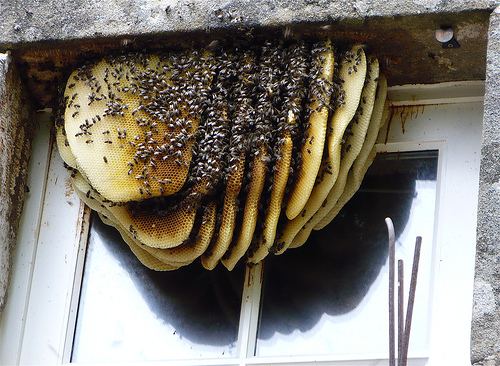
I put a box with no wax foundations on top of each of my hives a few weeks ago, to see if they would build some straight comb and fill it with honey. When you give bees space with no foundation, you have to keep an eye on them to discourage them from just building wild wavy honeycomb every which way. One frame had a nice straight comb started, but on another frame there was this beautiful 'art comb' begun. The last photo shows how it was oriented when hanging from the frame's top bar. Keep in mind that all the curves on this piece of comb are exactly how it was built by the bees- there was no sagging or bending to create these undulating folds. It's like a delicate coral.
I had to remove it because if it got larger I wouldn't be able to remove frames later on at all. In the wild, bees naturally construct comb shaped like beautiful hanging leaves.
It was a shame to have to cut this comb out, but it's certainly a lovely delicate and mysterious thing to have in the living room to show people. It smells wonderful too, pure beewax.
Hopefully the bees will try drawing some straighter comb next time.

Wednesday, August 25, 2010

August garden flowers

The summer garden is winding down, getting ready for the Fall garden again. Tomato and cucumber plants are soon to be exhausted, and I'll be planting new seed for cool-loving radishes and spinach again.

Late summer flowers around the house...


New purple coneflower (Echinacea)

Anise hyssop blooming in the front, nestled with leeks.
String beans at center, and kale to the right.

Beautiful sneezeweed (Helenium, or Helen's flower)
against
Russian sage.

A bumblebee enjoying the sneezeweed this morning.

Friday, August 13, 2010

Playing old-time music at the farmers' market

This was a couple of weeks ago. Some of us friends were playing old-time music at the farmers' market in our little town. We call our farmers' market band "Mixed Greens".
The young man has been my banjo student for the past few years. Now he has moved away and I miss him. Here at the market he sang a rousing version of "Old Joe Clark" and the crowd just loved it.


Monday, July 19, 2010

My bees doing their washboarding thing


I happened to notice one of my honeybee hives this afternoon having a 'washboard day'...really going to town on it. Washboarding is a bee behavior that is not entirely understood yet. You can see the bees move forward and back rhythmically, shuffling their front feet around on the surface of the hive, usually near the entrance. Perhaps they are merely cleaning the area, or perhaps they are applying some scent or substance and polishing it onto the surface.
I love to watch them do this.

Tuesday, July 6, 2010

July 5th

I played my banjo yesterday.
It was about 95F out, hot as blazes. Brian and I went to a friend's house to jump in their pool while they were off on vacation somewhere. Nothing like swimming in someone else's pool. After cooling off we played some fiddle tunes in the cool basement kitchen there with a guitar playing friend, and ate the salad I picked fresh from our vegetable garden just two hours before, topped with slivers of purple kohlrabi and neon orange nasturtium blossoms reminiscent of fireworks. Went home just before dark and my bees were bearding in the heat, hanging in a bee trapezesque glob from the hive, wings frailing in a blur like a million tiny exhaust fans hard at work.

Sunday, June 27, 2010

The end of June

Well it's just about the end of June now, Summer is here. The vegetable garden is bursting full. Here, the bee's borage is stealing the scene at the front of the middle bed, a three foot high constellation of pure twilight colored flowers, looking like blue shooting stars cascading from stems of furry pink...


Hard to believe that this previous photo was from May 13th, a mere six weeks or so ago:
Everything except the tomatoes was grown from seed planted directly in the ground.


Back to today... A view from the far end of the garden. Along the left rear bed are tomatoes, cucumbers, and sunflowers all supported by stakes.
Today after breakfast I spent a couple hours pulling out some patches of lettuce, radish, and spinach that were way past their prime and just beginning to get tough and bitter. Into the compost bin it all went (a giant wheelbarrow packed full), and I hoed up the spaces and planted various new seed. It was rejuvenating in a spiritual sort of way.
Years ago I never could have brought myself to yank all those greens out if any of it was still remotely edible. But I've changed my ways...I'm ruthless now! Of course knowing that it gets composted and thus cycled back in again makes it seem less awful. The reward is the joy I get from planting tiny new seeds with my bare hands...tucking them tenderly into the soil like tiny babies, gently patting a fine coverlet of soil over them.

I have small green tomatoes growing now, sunflower heads forming, tiny 1/2" baby cucumbers on the vines. I am getting to know some of the lettuce varieties better, so I know what I will plant more of next year and which types I won't repeat. Definitely more purple kohlrabi next year!

This was yesterday's dinner...
Adding little fresh chevre or mozzarella is the final touch along with the dressing:

The honeybees continue to expand their population and stores, so I added the first medium honey supers on top of each hive a few days ago. I am for the first time using foundationless frames in the new supers, and hopefully the bees will soon begin to draw all their own comb in the new frames, using just the popsicle stick guides I glued in along the tops as a base to start comb building from. We shall see!

Wednesday, June 16, 2010

My garden after a misty rain

I went out into my vegetable garden to take a few photos right after a morning rain. There was a beautiful intensity to the light, and everything was wet and sparkling. Click on any picture to see it bigger.


Purple kohlrabi.


I took a picture of this tiny yellow fly. It wasn't until I looked at the photo close up that I saw that it had pink eyes.


This is the beginning of a sunflower bud.


Variegated nasturtium leaves.


Kale leaves with rain drops.


One of my honeybees on a calendula blossom.


A ghostly dew-covered spiderweb on speckled lettuce.


This beautiful emerald green visitor comes by regularly. I think it is a small bee species, but I'm not quite sure yet.


My borage is starting to bloom. Twilight blue stars covered in diamonds.
I planted borage for the bees, so far it is attracting bumblebees.


'Divina butterhead' lettuce.


'Bull's Blood' beets.


'Quatre Saisons' French lettuce.


A purple finch made a nest right in a hanging basket of lobelia on our kitchen porch.
Sadly, when the eggs were only about a week old the nest was robbed and completely empty, and the mother finch had left. I suspect bluejays.