Showing posts with label mason and solitary bees. Show all posts

Sunday, April 22, 2012

Mason bee females beginning to nest, April 2012

Here is a little video taken a few days after the first video.
Instead of seeing bunches of eager males buzzing around focused on last year's tubes from which the females are beginning to emerge, in this new video we see females intent on choosing tubes to begin laying in. There are many horn faced mason bees and quite a few eastern Blue Orchard mason bees as well. Most of the bees you see now are the females, having mated already and beginning their nesting activities. The females are a bit larger and heavier than the males. Males have long antennae and sometimes a little white mustache!

More females will continue to emerge from the old tubes for another week or two, and there are males loitering around the area hoping for that possibility...lol! But the bees in the video that are actively rushing in and out of the new tubes now are almost all nesting females.

Saturday, April 21, 2012

Mason bees emerging and mating April 2012


In this video I describe what is going on at the nesting site on my porch. We have a new nesting box put up, with a capacity of 450 nesting straws, each of which can accommodate 4-6 cocoons.
Many male horn faced mason bees are the first to emerge this Spring and are impatiently waiting for the females to emerge. Males emerge first, females can take up to about 2 weeks before they all emerge. There are also blue orchard bees nesting here. Last years nesting tubes with cocoons are in the bags to the left, while the new clean nesting straws are in the box ready for the females to lay in this year.
Sorry about the occasional wind noise in the video.

Sunday, March 18, 2012

A new bigger mason bee box

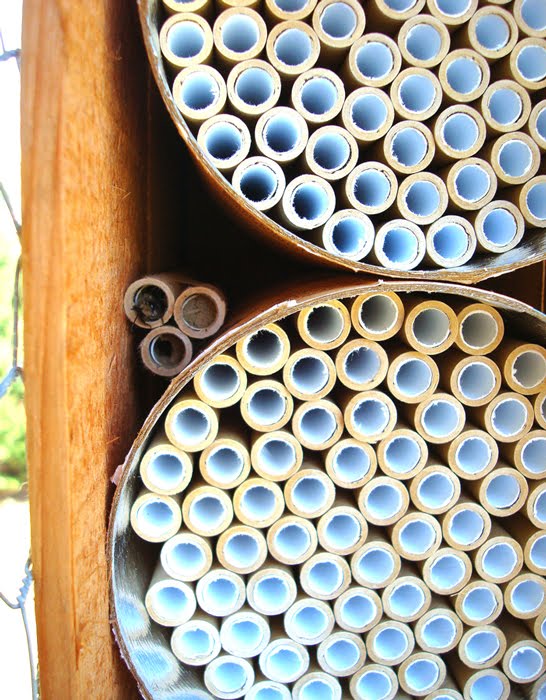
Brian made a new nesting box for our expanding solitary/native/mason bee population. This box holds a total of over 400 nesting straws, in 6 large cans. I found that large pineapple juice cans are just the right size for the nesting straws.  This one box actually holds more nesting straws than all three of my previous nesting boxes from last year combined, yet it's much easier to maintain and clean.  Click the image to enlarge it for viewing:


The chicken wire front keeps out woodpecker and squirrel predators. We can make a second identical box if need be, and hang it directly below this one. A second box may not be necessary this year. I anticipate that my immediate neighborhood would likely not support more mason bees than two of these boxes could possibly house- there is a limit to the local food/pollen supply after all. Honeybees can travel several miles for forage, but little solitary bees only forage a few hundred yards from their home base, thus their population is self-limiting based on the food supply in any given area.
In a few days I'll be putting the chilled dormant cocoons from last year out to emerge right next to this new nesting box. I'm just waiting until a few more flowers are blooming. It's a very early Spring here, but the fruit trees are still not flowering. Right now my 2011 cocoons containing new adult bees are still sleeping safely in my refrigerator veggie crisper drawer. It's almost time for emergence! A couple of days ago I was planting pea and spinach seed in my vegetable garden, and several male mason bees kept landing on my periwinkle blue skirt, apparently mistaking me for a giant morning glory. They were so sweet, but I felt a little sorry for them since not much is blooming yet. Obviously they were local wild bees who had emerged a bit early due to the unusually warm weather. It's quite possible that some of those bees will find this box and use it before my refrigerated bees are put out to emerge and mate.  Some of the straws have paper liners that carry the scent of last year's nesting activities, and that's a powerful lure to any nearby mason bees looking for nesting sites.

I really look forward to seeing this new elegant box bustle with nesting bees!

Tuesday, April 26, 2011

Little horn-faced bees mating!

Last winter I ordered a few cocoons of the little 1/4" long solitary 'Horn Faced' mason bee, (Osmia cornifrons) from Dave at Crownbees.com. Along with my two other species of solitary mason bees cocoons from last summer, I kept them cold all winter and only a few days ago I put them out to emerge as new adults, ready to immediately mate and start pollinating and nesting. (see my other posts about my mason/solitary bee nesting houses)
The weather has finally warmed up and dandelions are blooming at last! All my little mason bees have begun emerging from their cocoons. The males usually emerge first, and hang around the nest boxes waiting to pounce on the females when they hatch out of the cocoon tubes.  Today was my birthday, and it was also the birth day of many of the little solitary bees in the nesting boxes on my kitchen porch.


I was lucky enough to get some good photos today of one pair of my new tiny horn faced bees mating! The female has two small 'horns' jutting straight out from her face, she uses them to pack mud into the nesting cavities, thus making an individual chamber for each egg she lays.


Here are two pictures of the amorous couple, the smaller male positioned on top. Click on the pictures and you'll see nice big close ups:


I watched as the male performed some strange moves repeatedly. First he would hike his abdomen very high in the air...

Then he swung it back down and curled it tightly into a very hunched position...
He repeated these odd up/down 'hand stand curls' many times while holding the female still. I couldn't see that he was even making any sexual connection during all this, but I suppose he must have been taking care of business somehow-  lol!   After a while they stayed still for a while as in the first photo. Then the male unceremoniously flew off.  A 'one night stand'.  I watched to see what the female would do next...


Right after the male flew away, the female dragged her behind and squirted out this cream colored droplet and walked forward a few steps.  She cleaned her face for a moment, then flew off too. This droplet reminded me of watching bees poop, but the mason bee poo I have observed is gray, while honeybee poo is orange-brown. The mason bees poop immediately upon emerging from their cocoon before they go anywhere, and this female had probably already done that before mating.
This was a thinner liquid, and almost white.  At any rate, she seemed satisfied with her birthday's chain of events and went on her way.  See her little face horns?  She also has shorter antennae than the smaller male.  She's off to find food, pollinate flowers, and starting nesting!

Tuesday, November 9, 2010

End of year solitary bee nests

Well it's November now, cold enough to take down my solitary and mason bee nesting blocks and store them in the unheated garage for the winter. There they will be protected from ice, freezing rain, winds, and mice.

My top wooden mason bee nesting block has about 10 tubes that are either partially or completely filled with cocoons and capped with mud...


The middle nesting site consists of two 'cans' of nesting tubes. As you can see, the bees really liked the lower can and filled almost all the 60 tubes with cocoons and mud. They used a few of the tubes in the upper can too, but only after the lower can was basically full. My best guess is that because the morning sun hits the lower can first in the chilly Spring mornings, the bees may have liked that warmth...


The bottom wooden block was specially made with smaller diameter tubes of 1/4"- I was experimenting to see if that would attract the smaller leafcutter bees, which I have read like slightly smaller tubes than the blue orchard bees use. I didn't see much action there this year, but I did put the box up a little late in the season.
However, late in the summer there was one single very small bee who kept coming and going there, and it managed to fill just ONE tube before it disappeared. I noticed the tube was not capped with the usual brown mud. Instead, it was capped by a strange dark black-green mash that seemed like dark green tar. It looked to be a paste made from chewed leaves or vegetation. Because it didn't appear to use any neatly cut leaf pieces, but used a paste instead, I am wondering if it is something different from a leafcutter bee.
I'll be asking around to try to figure out what kind of bee uses this capping. The bee itself was a bit hard to see when it was working- somewhat non-descript and very small and fast moving...but it did look appear to be a bee rather than a wasp. I will be watching this tube very carefully next Spring!...click the picture for a close up view:


In all, I started my first Spring of mason/solitary bees with six bought tubes of blue orchard mason bees....and wound up with two or perhaps three species of solitary bee cocoons, filling between 60-70 tubes.  I estimate each tube has anywhere between 3 and 5 cocoons in it, so that will be around 180 to 350 new little solitary bees emerging next Spring to populate the neighborhood!  :)  I will have to add at least one more nesting box, for sure.  I may try to get a neighbor or two involved.

Wednesday, August 25, 2010

August garden flowers

The summer garden is winding down, getting ready for the Fall garden again. Tomato and cucumber plants are soon to be exhausted, and I'll be planting new seed for cool-loving radishes and spinach again.

Late summer flowers around the house...


New purple coneflower (Echinacea)

Anise hyssop blooming in the front, nestled with leeks.
String beans at center, and kale to the right.

Beautiful sneezeweed (Helenium, or Helen's flower)
against
Russian sage.

A bumblebee enjoying the sneezeweed this morning.

Wednesday, May 5, 2010

Mason bees laying and nesting...

Just a little video showing the wonderful progress that has been made in my solitary mason bee nesting houses. 24 tubes filled with brood chambers and sealed up with little mud doors so far! A lovely warm sunny May morning...

Wednesday, April 21, 2010

First mason bee nesting tube is full!

A nice warm 70F sunny day today, and the solitary bees are very busy. Today is a special day, April 21 2010... today the very first mason bee nesting tube was filled and sealed with mud! I watched the female bringing in balls of mud and putting the finishing touches on the outermost mud plug...

Wednesday, April 14, 2010

The leafcutter bee block is up...


I asked Dave of Dave's Bees to make me a special nesting block for leafcutter bees.
Leafcutter bees line and seal their egg chambers with circular pieces of green leaves that they chew off with their precise mandibles. This is different from the mason bees, who use mud to seal their egg cocoon chambers. Leafcutter bees supposedly like slightly smaller and shorter tubes (1/4" diameter x 4" length) than mason bees like (5/16" diam. x 6" length). They also do their nesting just a bit later in the Spring than the mason bees typically do, from what I have read. So Dave made me a really nice nesting block with the requested sized holes (lined with parchment so as to discourage mites and fungus by replacing the liner each year).
I put it up underneath my other two boxes. The new leafcutter bee box is at the bottom in the photo, on our back kitchen porch post. The morning sun shines right at the fronts of the nesting blocks, warming up the bees nicely on chilly mornings for a couple of hours. Again, I stapled on chicken wire to keep any hungry woodpeckers from getting the bees or cocoons. It will be very interesting to see who, if anyone, moves into the new bee block with the smaller holes. (Clicking the blog pictures will enlarge them)

Here just before sunset today I got a couple of shots of the Osmia taurus mason bee going in and out of one of the tubes. This little bee must be living around here and discovered the nice nesting tubes and moved in right alongside my blue orchard mason bees! They seem to be getting along just fine. It's nice to have two different species to watch. The first photo shows her flying in, the next photo is when she emerged from the tube to do another pollen run. It's very hard to photograph them, as they seldom seem to stay still for a second, unlike honeybees who often laze about photogenically. ;)


And here is my first video of my solitary bees using the nest boxes on my kitchen porch!:

Fabre and my dreams as a 12 year old girl


Too often I find that in garden discussions, the subject of insects is limited to referring to them as 'pests' and subsequently discussing practical ways to kill insects in one way or another. I find this attitude a bit odd.
Consider that experienced gardeners seem fully aware of the direct relationship between their healthy plants and the soil conditions and nutrients that directly effect them. They recognize that plants do not exist in complete isolation from their natural environment, that there is in fact an ecosystem that is best kept in healthy balance if one desires optimum results in the garden. Yet beneficial garden insects are rarely given a thought, except for the usual advice on how to get rid of garden pests.

In reality, most insects in our gardens are beneficial and work tirelessly to contribute to a healthy ecosystem despite our best efforts to destroy them at every turn. Airborne insects and soil dwelling creatures pollinate our flowers, fruits, and vegetables, they fertilize and aerate the soil and help break down waste and bacteria. I feel a healthy population of industrious and beneficial garden insects and invertebrates of various kinds are important to garden health in the same way that healthy soil is important.

When I was a young girl I used to read the wonderful writings about insects by French naturalist Jean-Henri Fabre. Fabre's lifetime work ever since boyhood was observing and studying the habits of all manner of nature's creatures in the wild and in his immediate surroundings, insects in particular. His field studies were written in a very enjoyable and accessible style- The Mason Bees, The Life of the Spider, Insect Adventures...

I can still find my young 12 year old signature on one of the worn library books in my hometown here, books written by naturalist authors Fabre, Edwin Way Teale (Grassroot Jungles, Dune Boy), Konrad Lorenz (King Solomon's Ring), and Gerald Durrell (Birds Beasts and Relatives, My Family and Other Animals). Musty books even back then almost 45 years ago, that I avidly borrowed from the library and read as a young girl, dreaming about becoming a naturalist one day myself. Life had other plans for me, and I never became a naturalist, though I never ceased studying and observing insects, plants, and all manner of animals with a passion.


One can peruse a very delightful sampling of Fabre's writings and observations on this wonderful website I recently stumbled upon, wholly dedicated to his work: http://www.efabre.net/


When we study and understand the lives of insects and other tiny hard working creatures in the garden, we can better appreciate the vital part they play in the natural world around us, and in our garden too. We then see the garden environment as a whole picture instead of the strange partial view we've adopted by mentally filtering out what we might consider to be the 'undesirables', in other words every creature less superficially appealing than butterflies, chickadees, cute toads, and hummingbirds.
Let's try to learn little ways of providing hospitable insect habitats within our gardens and yards, providing water and shelter, especially avoiding the use of poisons on our plants and in our soil, allowing some areas for protective tall seeded grasses or brush, letting a hollow tree or rotting log remain in place a bit longer to house animals and birds and even bees, perhaps allowing bees to enjoy the pollen of 'weed' flowers such as dandelions (a bee favorite). The whole concept of an artificially sterile lawn devoid of all wildlife is getting so old.

Let's stop viewing insects merely as pests to be ruthlessly eliminated. Indeed, if we did successfully kill off all the insects with our continued obscene use of pesticides and herbicides...our planet (ourselves included) would die along with them.

Friday, April 9, 2010

Solitary bees are discovering the nesting boxes...

I'm quite excited! Yesterday was a beautiful warm sunny day, and things are really hopping at the solitary bee boxes.
First, I was able to see another blue orchard mason female bee emerge from the cocoon tubes I had purchase. So things are still happening in that department.
But even more exciting is that over the past two days there have been quite a few female mason bees coming to the boxes and going in and out of the new nesting tubes!

Here are two blue orchard mason bee females using the tubes in my drilled wooden nesting block made by Dave at Dave's Bees:


Here is a blue orchard bee going into tubes in my 'can' nesting unit... it's easy to identify the blue orchard mason bees by their beautiful metallic blue sheen and black body:


I was amazed to see a second species of mason bee coming and going to my nesting sites. This other species is a soft warm brown color and has a fuzzy overall look, clearly a different solitary bee altogether than the blue orchard mason:
I asked on a bee forum what species this might be, and it was suggested by a knowledgeable person that it might be Osmia taurus. After looking at many online images I agree that this is likely Osmia taurus. This solitary bee species has no common English name...yet. I think I will invent one for my own use!. It is not one of our native solitary bees, but was imported to Maryland in the northeastern U.S. from China and Japan many years ago and is now established here all over the northeastern U.S. where I live. Unfortunate that there are introduced species around, but not much I can do to change that ...so the welcome mat on my little bee inns will remain for all little bees who need an abode. In that same photo you can also see the black feet of a blue orchard bee (Osmia lignaria) peeking out from one of the other tubes.

Here is an Osmia taurus bee-girl peering out happily from her chosen tube...
Click on any picture and it will enlarge.

Friday, April 2, 2010

My mason bees are hatching!

My solitary mason bee cocoons are hatching!!
After 4 days of over 50F in the nesting box out on my kitchen porch, this morning I noticed one of the little mud caps was missing on one of the six cocoon tubes, and I could see the empty chamber. The mud cap had been there intact yesterday. I could faintly hear little clicking noises from the tubes...somebody was inside the tube trying to chew their way out!

Shortly after that, I saw a couple other mud caps coming off in little chunks. I took a flashlight and a magnifying glass and I could see the fuzzy brown movements of a wiggling cocoon inside. By hanging around the box and checking every few minutes, I was able to watch two new adult mason bee males emerge from their cocoons! I had to be very quick with my camera, because once they exited the tube they only sat for a few moments stretching their wings before they took off flying to parts unknown! Here I thought they were supposed to hang around the box waiting for females, but no, they seemed to have an agenda. Maybe they were thirsty or just doing orientation flights?

Anyway, I'm pretty excited to know I was responsible for adding some new little mason bees to my neighborhood. I feel lucky to have seen at least two being born and to have gotten any pictures at all!
I think the rest will likely hatch later today and tomorrow. I hope to see the bees come back and hang around the nesting boxes soon. I'll be watching the garden flowers and the nesting boxes over the coming weeks...

I love that in the close up you can see a little bit of blue metallic sheen on the abdomen of the first male...and look at his little antennae sections! Click on the photos and they will enlarge to see more details.


Tuesday, March 30, 2010

Time to put out the mason bee cocoons

Yesterday, I put my 6 tubes of cocoons out in the lower mason bee box, alongside the two 'cans' of nesting tubes, inside the box for protection.
Tomorrow will be in the mid 50'sF, followed by about 9 more days predicted in the high 50's through the 70's (!!) Surely it will be hatching time if the cocoons I bought are alive.
If not, then I will have to wait and hope for the wild local solitary bees to find my boxes. I have high hopes.

My two boxes are right on the back porch near the kitchen door, and several visitors have already been examining them and asking about them-

First, Jim the mailman who delivers our mail to the kitchen porch. Jim loves to photograph flowers close up, and he also got a kick out of delivering my composting worms last year for my worm bin, so naturally he loved hearing about the new little bee condos.
Then, the milkman who delivers our milk in glass bottles every week to the milk box on the porch there. I caught him peering right into the boxes this morning trying to see what the heck was in there. lol! He loved my explanation and seemed fascinated.
Also, the lady who comes to cut my husband's hair every 6 weeks or so. She runs a 4H club, and she actually got all the kids to do a worm composting bin project last year after she was inspired by my worm bin. Today I told her maybe their next 4H project will have to be native bee nesting boxes. She seemed mighty interested. ;)

Thursday, March 25, 2010

First plantings of the year

Lettuce seedlings from my garden, last year (2009)

Tomorrow night will be that last deep freeze- predicted about 18F. After that, I don't think there will be any more nights colder than 25F degrees or so. So today I got out in the new vegetable garden and began some modest direct seeding of some of the cold weather loving Springs veggies.
I used a garden fork to do some deep soil loosening to a depth of about eight inches, then I sprinkled some organic fertilizer and hoed that in, then made furrows and began to plant a few small rows of this and that. My method will be to practice succession planting of seeds directly in the ground- one or two 3 foot rows of any particular thing, and then planting more short rows as the season progresses. This gives a more constant supply than simply planting one or two main patches at a time, of say beets or carrots. Greens do especially well with seeding small amounts more often.

Today I began with a couple of short 3 foot rows each of:
Chatenay carrots
Winter red Russian kale
White Russian kale
Rouge d'hiver lettuce
Nevada Batavian lettuce
Japanese bunching onions
Springer spinach
Gigante inverno spinach

Later on I'll plant Swiss chard, leeks, chioggia and bull's blood beets, some other lettuces, bok choy, radishes, and purple kohlrabi. Then I'll wait a couple more weeks before planting seeds of veggies that respond better to slightly warmer temperatures.

I learned from experience that I should sprinkle the seeds more carefully and slowly, really one seed at a time along the furrow. Last year I had to thin out way too many seedlings of lettuce, beets, carrots, radishes, ..it was a sad lesson to pinch out those poor adorable extra seedlings and basically waste precious seed. Now I will only plant a few things on any given day, preparing the soil and planting the seed with more care and precision.

This weekend I will also put out my blue orchard mason bee cocoons into the nesting boxes. I can't wait to see if they hatch out in a week or two!

Thursday, March 18, 2010

Mason Bee nesting boxes are up

Today Brian helped me get the two new nesting boxes up for our native pollinating bees- the blue orchard mason bees.


The upper box is a solid block of wood drilled with long tunnels, in which the mason bee female will lay her series of cocoon chambers in sequence, separating each cocoon with a little wall of mud ('bee masonry' if you will). All the tunnels are lined with parchment paper which will discourage the accumulation of mites, fungus and such. The paper liners get replaced every Spring.
The lower box contains two 'cans' which are filled with cardboard nesting tubes, each of which is also lined with parchment paper.
The boxes are facing SE to catch the morning sun, and I installed chicken wire guards to keep woodpeckers from trying to get to the bee larvae in the nesting tubes.

It's still too early to put out the actual mason bee cocoons I have hibernating in tubes in the refrigerator alongside the cucumbers and alfalfa sprouts in the vegetable drawer. Another big cold snap is in the forecast for next week, so I'll likely put the cocoons out right after that. I hope the boxes will also attract some of the mason bees I have seen foraging in my garden in past years. I know there are some nearby somewhere. Between watching for local native mason bees and getting new honeybees, it should be an interesting season!
In the photos, you can see a few purple crocus blooming on the lawn, but that's about the only thing blooming yet.

Monday, March 8, 2010

Gardens and bees....

Even though there is snow on the ground and it's in the 20's F at night, I'm still getting excited about Spring almost here. I see in the forecast that daytime highs are now going to be in the 40's and 50's rather than the 30's and 40's. Big difference!

My food gardening plans include planting a few dozen blueberry and raspberry bushes, in addition to being able to utilize the big new veggie garden for a whole season for the first time starting this Spring. My last post detailed the seeds I received in the mail.

My Compost bin of eisenia foetida composting earthworms are doing just fine in my basement. Their metabolism has slowed down during the cool basement winter temps, but as Spring progresses the basement will be warmer and they will speed up again with the kitchen scraps, eggshells, and cardboard/paper roughage I feed them. There are several thousand worms of different developmental stages in the bin, working various of the three tray levels. I have a couple of gallons at least of pure castings already waiting to add to the garden, and more is in the works from the hard working little worms.

My honeybee plans for the new year are to rev up to between 2 and 4 hives, depending on how things go. I did order some new bees in the mail, and of course I worry about them in transit, but things usually go smoothly. I also will be attending bee club meetings and/or a short 'bee school' course, both offered by local beekeepers.
Those mail order honeybees will not arrive until first week of May. But there is plenty to do in the meantime, inspecting and cleaning up my current hive and building new frames and settin gup the additional new empty hives in preparation.
I also plan to set out a 'swarm bait' small hive box, with used comb, bee pheromones, and lemongrass oil- all of which are irresistable to swarm scout bees out looking for a new home to move into.

The other thing I have looked into and ordered are nesting supplies, houses, and some cocoons of our local native bees- the blue orchard mason bee. Honeybees are actually European imports. Our U.S. native bee pollinators are solitary small bees who do not maintain a hive society, do not sting, and do not make honey. But they do pollinate trees and gardens like mad, are beneficial to our planet in many ways, and are cute as a button as well. What a great little bee to encourage and keep in your garden or yard, especially for those who are not able to keep honeybee hives where they live.
I know they are in my area, because I saw some on my flowers during the past two summers. I plan on providing ideal nesting tube houses, water, and a source of nest-building mud for the little blue mason bees to thrive on so they hang around my house and garden. Learn more about providing nesting and housing environments for solitary native bees: HERE. I ordered mason bee supplies and houses from HERE, and HERE.


Here is a mason nesting box i bought from Dave's bees...it came complete with paper tube liners all set up for the first year:
And go HERE to watch Dave's video in case you'd like to build a mason bee nesting box yourself!

We should all consider providing for our beneficial insects and other wild animal friends who are struggling. I ordered a bat house as well, which we will attach to the eaves of the house.


More cool links to sites about solitary native bees and mason bees:
Pollinator paradise
Solitary Bees
Knoxcellars
Crown Bees
Dave's Bees
Seedcake.com
Foxleas.com
WildBienen
Freshdirt
ncsu.edu
Bee Species photo collection
Jean-Henri Fabre's The Mason Bees
Wings In Flight
Native Bees info
French solitary bee blog
xerces society
pencilandleaf.blogspot