Friday, October 29, 2010
Friday, October 22, 2010
Double Rainbow
Last month in September after an autumn rainstorm, we saw an incredible, once-in-a-lifetime double rainbow arching completely over the field right behind our back yard. To say it was breathtaking is an understatement. It lasted about 20 minutes. The best part was how it divided the whole sky into dark and light in a strange shimmering way, splitting the entire sky perfectly into dark and light. The hill and trees underneath the rainbow were similarly split between deep shadow and brilliant sun.
My little digital camera could not capture the vast spread of it across the sky, so I had to take photos of the left side, right side, and middle, and then piece the parts by hand into a composite panorama, the result of which you see here. We'll never see anything like this again. Click on the photo to enlarge it to full size.
A friend of mine who was down the hill right in the village on Main Street at the time, told me a crowd of people came out of the local restaurant and marveled at the rainbow in a crowd on the street. My friend's companion commented that it looked like it was directly over our house, and indeed that's how it seemed to us as well! It was magical.
My little digital camera could not capture the vast spread of it across the sky, so I had to take photos of the left side, right side, and middle, and then piece the parts by hand into a composite panorama, the result of which you see here. We'll never see anything like this again. Click on the photo to enlarge it to full size.
A friend of mine who was down the hill right in the village on Main Street at the time, told me a crowd of people came out of the local restaurant and marveled at the rainbow in a crowd on the street. My friend's companion commented that it looked like it was directly over our house, and indeed that's how it seemed to us as well! It was magical.
Wednesday, September 29, 2010
The virtuous radish
Now that the heat of summer is over and the cool Fall nights have begun, it's time to plant new seed of cool-loving vegetables and greens. These are many of the same veggies that thrived in cool Spring.
About 3 weeks ago I began planting new little rows of spinach, carrot, bok choy, radishes, beets, and new baby kale and swiss chard. I also have been trying out new types of seeds for various Asian greens to see what they do.
My favorite radish is the long French Breakfast radish.
The trick to radishes, since they grow so quickly in cool weather, is to plant a new row of seed about once a week, with only about 15 seeds in the row, one inch or so apart. This provides a steady source of fresh young crispy radishes, rather than having too many radishes ready to harvest at once, or worse yet getting older and fibrous in the ground while waiting too long to be picked. Treat your seeds like the precious treasures they are, and space them out carefully in succession for the best freshest supply of delicacies.
When radishes are still young and fresh, their green tops can be cooked quickly in a very small amount of water and eaten like spinach. Incredibly nutritious! The slightly furry-prickly leaves quickly soften and shrink in volume by about two thirds when cooked, just like spinach does. I like to cook a whole large bowlful in about 1/2 cup of water, add a small pat of butter and a little sea salt at the end, and consume the nutritious broth right along with the radish greens.

Labels:
bread and cooking,
gardening
Tuesday, September 21, 2010
From the garden
Today I picked a big bowl each of carrots, cherry tomatoes, and string beans from our vegetable garden.This is about the fourth bowl of green beans and the second batch of carrots we've gotten from the very small patches I sowed- each only about one square yard's worth of garden space.
We've had lots of cherry tomatoes for several weeks now, but tomatoes are winding down. The single large tomato in the photo is our last of the large tomatoes- we've had a drought and the tomato vines are giving up the ghost.
The carrot variety is "Royal Chatenay", a short fat carrot. I like the shorter carrots since I don't have to dig eight or nine inches down to loosen the soil when sowing the seed. Instead, five inches with a garden fork will do them nicely. I probably should have pulled these carrots when they were smaller, but I was busy with other things. Some of the carrots were one and a half inches thick! They taste wonderful anyway, like all fresh grown carrots do.
The green bean is a Blue Lake bush type. I like the bush beans rather than pole beans for my situation- they won't grow in a tall climbing shape that might block the sun from other plants. My protected vegetable garden space is not limitless, so I have to plan carefully.
We'll be having carrots and green beans with mashed potatoes for dinner the next couple of nights.
The large single flower is Tithonia, or Mexican sunflower. A friend gave me three tiny seedlings of it. The plant gets quite big and has large showy bright orange flowers. This stem blew over in the wind and broke so I put the flower in a glass of water.
Labels:
bread and cooking,
gardening
Thursday, September 16, 2010
Crazy Comb


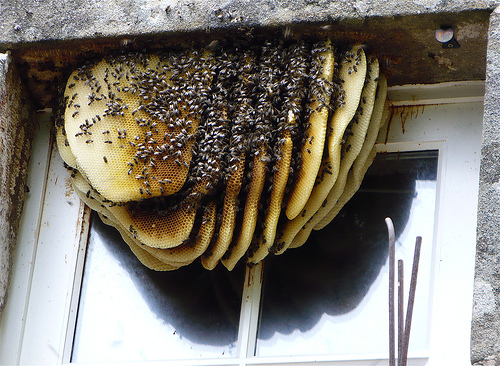
I put a box with no wax foundations on top of each of my hives a few weeks ago, to see if they would build some straight comb and fill it with honey. When you give bees space with no foundation, you have to keep an eye on them to discourage them from just building wild wavy honeycomb every which way. One frame had a nice straight comb started, but on another frame there was this beautiful 'art comb' begun. The last photo shows how it was oriented when hanging from the frame's top bar. Keep in mind that all the curves on this piece of comb are exactly how it was built by the bees- there was no sagging or bending to create these undulating folds. It's like a delicate coral.I had to remove it because if it got larger I wouldn't be able to remove frames later on at all. In the wild, bees naturally construct comb shaped like beautiful hanging leaves.
It was a shame to have to cut this comb out, but it's certainly a lovely delicate and mysterious thing to have in the living room to show people. It smells wonderful too, pure beewax.
Hopefully the bees will try drawing some straighter comb next time.
Labels:
honeybees
Wednesday, August 25, 2010
August garden flowers
The summer garden is winding down, getting ready for the Fall garden again. Tomato and cucumber plants are soon to be exhausted, and I'll be planting new seed for cool-loving radishes and spinach again.
Late summer flowers around the house...
Labels:
gardening,
honeybees,
mason and solitary bees
Friday, August 13, 2010
Playing old-time music at the farmers' market
This was a couple of weeks ago. Some of us friends were playing old-time music at the farmers' market in our little town. We call our farmers' market band "Mixed Greens".
The young man has been my banjo student for the past few years. Now he has moved away and I miss him. Here at the market he sang a rousing version of "Old Joe Clark" and the crowd just loved it.


The young man has been my banjo student for the past few years. Now he has moved away and I miss him. Here at the market he sang a rousing version of "Old Joe Clark" and the crowd just loved it.


Monday, July 19, 2010
My bees doing their washboarding thing
I happened to notice one of my honeybee hives this afternoon having a 'washboard day'...really going to town on it. Washboarding is a bee behavior that is not entirely understood yet. You can see the bees move forward and back rhythmically, shuffling their front feet around on the surface of the hive, usually near the entrance. Perhaps they are merely cleaning the area, or perhaps they are applying some scent or substance and polishing it onto the surface.
I love to watch them do this.
Labels:
honeybees
Tuesday, July 6, 2010
July 5th
It was about 95F out, hot as blazes. Brian and I went to a friend's house to jump in their pool while they were off on vacation somewhere. Nothing like swimming in someone else's pool. After cooling off we played some fiddle tunes in the cool basement kitchen there with a guitar playing friend, and ate the salad I picked fresh from our vegetable garden just two hours before, topped with slivers of purple kohlrabi and neon orange nasturtium blossoms reminiscent of fireworks. Went home just before dark and my bees were bearding in the heat, hanging in a bee trapezesque glob from the hive, wings frailing in a blur like a million tiny exhaust fans hard at work.
Sunday, June 27, 2010
The end of June
Well it's just about the end of June now, Summer is here. The vegetable garden is bursting full. Here, the bee's borage is stealing the scene at the front of the middle bed, a three foot high constellation of pure twilight colored flowers, looking like blue shooting stars cascading from stems of furry pink...

Hard to believe that this previous photo was from May 13th, a mere six weeks or so ago:
Everything except the tomatoes was grown from seed planted directly in the ground.
Back to today... A view from the far end of the garden. Along the left rear bed are tomatoes, cucumbers, and sunflowers all supported by stakes.
Everything except the tomatoes was grown from seed planted directly in the ground.Back to today... A view from the far end of the garden. Along the left rear bed are tomatoes, cucumbers, and sunflowers all supported by stakes.

Today after breakfast I spent a couple hours pulling out some patches of lettuce, radish, and spinach that were way past their prime and just beginning to get tough and bitter. Into the compost bin it all went (a giant wheelbarrow packed full), and I hoed up the spaces and planted various new seed. It was rejuvenating in a spiritual sort of way.
Years ago I never could have brought myself to yank all those greens out if any of it was still remotely edible. But I've changed my ways...I'm ruthless now! Of course knowing that it gets composted and thus cycled back in again makes it seem less awful. The reward is the joy I get from planting tiny new seeds with my bare hands...tucking them tenderly into the soil like tiny babies, gently patting a fine coverlet of soil over them.
I have small green tomatoes growing now, sunflower heads forming, tiny 1/2" baby cucumbers on the vines. I am getting to know some of the lettuce varieties better, so I know what I will plant more of next year and which types I won't repeat. Definitely more purple kohlrabi next year!
Years ago I never could have brought myself to yank all those greens out if any of it was still remotely edible. But I've changed my ways...I'm ruthless now! Of course knowing that it gets composted and thus cycled back in again makes it seem less awful. The reward is the joy I get from planting tiny new seeds with my bare hands...tucking them tenderly into the soil like tiny babies, gently patting a fine coverlet of soil over them.
I have small green tomatoes growing now, sunflower heads forming, tiny 1/2" baby cucumbers on the vines. I am getting to know some of the lettuce varieties better, so I know what I will plant more of next year and which types I won't repeat. Definitely more purple kohlrabi next year!
This was yesterday's dinner...
Adding little fresh chevre or mozzarella is the final touch along with the dressing:

Adding little fresh chevre or mozzarella is the final touch along with the dressing:

The honeybees continue to expand their population and stores, so I added the first medium honey supers on top of each hive a few days ago. I am for the first time using foundationless frames in the new supers, and hopefully the bees will soon begin to draw all their own comb in the new frames, using just the popsicle stick guides I glued in along the tops as a base to start comb building from. We shall see!

Labels:
bread and cooking,
gardening,
honeybees
Wednesday, June 16, 2010
My garden after a misty rain
I went out into my vegetable garden to take a few photos right after a morning rain. There was a beautiful intensity to the light, and everything was wet and sparkling. Click on any picture to see it bigger.
Purple kohlrabi.

I took a picture of this tiny yellow fly. It wasn't until I looked at the photo close up that I saw that it had pink eyes.
This is the beginning of a sunflower bud.

Variegated nasturtium leaves.

Kale leaves with rain drops.

One of my honeybees on a calendula blossom.

A ghostly dew-covered spiderweb on speckled lettuce.

This beautiful emerald green visitor comes by regularly. I think it is a small bee species, but I'm not quite sure yet.

My borage is starting to bloom. Twilight blue stars covered in diamonds.
I planted borage for the bees, so far it is attracting bumblebees.


'Divina butterhead' lettuce.

'Bull's Blood' beets.

'Quatre Saisons' French lettuce.

A purple finch made a nest right in a hanging basket of lobelia on our kitchen porch.
Sadly, when the eggs were only about a week old the nest was robbed and completely empty, and the mother finch had left. I suspect bluejays.


Purple kohlrabi.

I took a picture of this tiny yellow fly. It wasn't until I looked at the photo close up that I saw that it had pink eyes.

This is the beginning of a sunflower bud.

Variegated nasturtium leaves.

Kale leaves with rain drops.

One of my honeybees on a calendula blossom.

A ghostly dew-covered spiderweb on speckled lettuce.

This beautiful emerald green visitor comes by regularly. I think it is a small bee species, but I'm not quite sure yet.

My borage is starting to bloom. Twilight blue stars covered in diamonds.
I planted borage for the bees, so far it is attracting bumblebees.


'Divina butterhead' lettuce.

'Bull's Blood' beets.

'Quatre Saisons' French lettuce.

A purple finch made a nest right in a hanging basket of lobelia on our kitchen porch.
Sadly, when the eggs were only about a week old the nest was robbed and completely empty, and the mother finch had left. I suspect bluejays.


Labels:
gardening
Thursday, June 3, 2010
Checking bee pupae for mites
Ok some might find this a little gross or even heartless, but it's for the overall good of the bees.My honeybees came from a 'natural minded' beekeeper who doesn't treat with pesticides for mite control or antibiotics for disease control. They seem pretty healthy and I've had them about six weeks. But one of the biggest problems honeybees face these days is varroa mites. Just about all hives in the U.S. have them now, or else they get them from nearby hives, so it's good to periodically get an idea of just how many mites there are amongst your hive population. Monitoring mite levels can give you a warning when something is going wrong and give you time to correct it in various ways.
To check for my hives' mite load, I first put a frame of specifically sized drone (male bee) foundation in each of my two hives. Varroa mites particularly target the larger drone cells in which to breed, attaching themselves to the drone larvae and pupae, sucking on them while the pupae develops in the capped cell, and emerging already attached to the adult drone bee. The affected drone bee is weakened and sometimes deformed by the mites, and the mite reproductive cycle continues.
Yesterday I removed the two 'mite bait' frames of capped drone brood from my hives, put them in the freezer overnight to quickly kill the larvae and whatever mites might be there, then I thawed the frames today to examine them.
I was delighted to find almost no mites at all on the drone larvae and pupae. I pulled about 30 dead drone pupae from their cells, and among the 30 I found only one lone varroa mite.
In this picture you can see the capped drone brood still on the frame in the background, and on the paper towel a few grub-like drone be larvae, and some immature developing drone bee pupae with darkening eyes. I removed the single little red mite I found on one pupae and placed it on the paper towel to the right in the photo so you could see it. It looks like a shiny little reddish-brown bead with tiny legs.
When these varroa mites run rampant they can destroy a whole hive of bees. But if their population remains modest the bees have little trouble living with them.
My drone pupae examination was very encouraging! I needn't worry about combating mites at the moment. I put the thawed drone frames back in the hives where they had been. The worker bees will quickly clean out the dead pupae, repair the comb, and the queen will lay new drone eggs in it. I will now let the bees raise the next couple of batches of drones in peace. I'll probably check the mite levels again in about 6 weeks.
If there had been a lot of mites, I would start more regularly pulling and freezing those drone frames when they are capped, since that is where the varroa mite concentrates its breeding activity. Some beekeepers use this mite 'bait frame' method to keep mite populations under control instead of using miticide/pesticide applied inside the hive to kill the mites. I would much rather freeze some drone pupae than apply pesticides to my hives. The bees do raise additional drones on the edges of 'regular' brood frames anyway, so there will always be some drones in the hive to mate with nearby queens.
But for now, I can relax... my bees are doing well on their own.
Labels:
honeybees
Tuesday, June 1, 2010
Vegetable garden...June 1, 2010
A few photos of my vegetable garden on June 1st. (click on any picture to see a larger view) We have been eating an abundance of various lettuces and salad greens. The colors and textures are so beautiful on a cloudy morning...
A general view of the garden. Tomatoes and cucumber vines are staked all along the right side bed.
Borage in the foreground. Bees love the little star-like blue flowers. Veronica is blooming in the background.
Speckled trout back lettuce
Purple kohlrabi
Black seeded Simpson, and Red Deer Tongue in the foreground.
Front to back: Swiss chard, Red deer tongue, Black seeded Simpson, and scallions.
Spinach and cilantro.
French Breakfast radishes.
Pickling cucumbers.
Red deer tongue and Quatre Saisons lettuce.
From top left corner down: Bull's Blood beets, then lettuces romaine Tin-Tin, Speckled Troutback, Red deer tongue, and Quatre Saisons lettuce. (green lettuces on the right are unknown volunteers from last year.)
Nasturtium, worth growing just to look at the leaves.
Rouge Grenoble lettuce.
On the left, Buttercrunch lettuce.
One of my honeybees on the Veronica.
A Tri-colored bumblebee on Veronica blossoms.
Labels:
gardening
Subscribe to:
Posts (Atom)